Get this delivered to your inbox
Real problems, practical fixes for leaders of international teams. Published weekly.
✓ You’re subscribed. Check your inbox to confirm.
One thing I’ve been thinking about a lot lately is how easily we assume that cross cultural pitching — the structure, the flow, the logic — is the same everywhere. Most of us in Western business environments grow up with a very particular model: be clear, be direct, state the problem, sell the solution.
It’s clean, efficient, and very much aligned with low-context communication cultures, where the message is mostly carried by the words themselves. That model works well in the environments it comes from, and it also shapes how we approach pitching across cultures more broadly.
But when you step into different cultural contexts, that approach doesn’t always land in the same way.
When Pitching Across Cultures Doesn’t Land
When I’ve worked with teams operating across Europe and into East Asia, one thing becomes very clear quite quickly: the issue isn’t whether people understand your pitch. It’s whether the structure of your pitch matches how they expect information to be presented.
In many East Asian business contexts, communication is higher-context. Meaning sits more in relationships, hierarchy, shared understanding, and what is implied rather than explicitly stated. So while a Western investor might expect you to move quickly into the problem statement, someone in Japan, China, or Korea may be wondering why you are moving so fast.
From their perspective, you are skipping the part that gives the pitch its foundation.
The Western Logic: Let’s Get Straight to It
The Western model of cross cultural pitching is familiar to most of us:
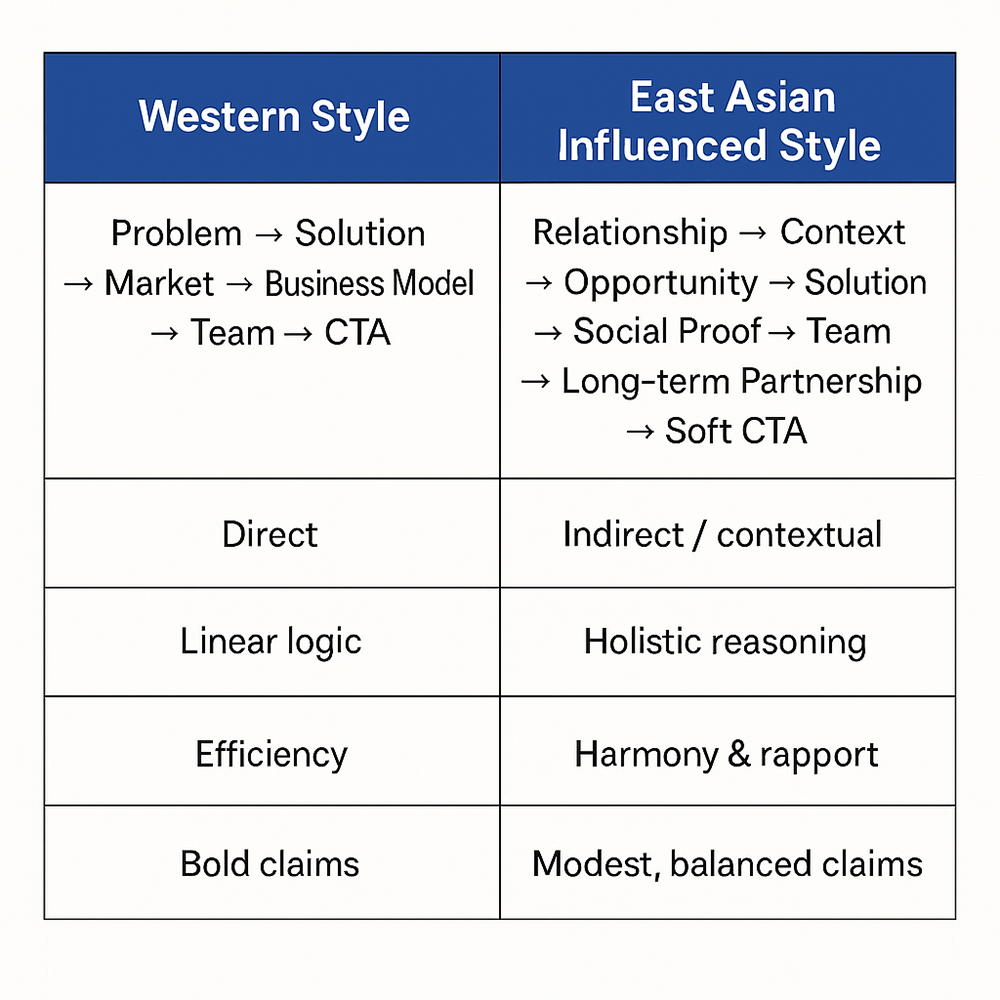
Problem → Solution → Market → Business Model → Team → Call to Action
It is linear, direct, and efficient. It reflects a broader cultural preference for clarity and speed, and it aligns closely with how cross-cultural communication in teams tends to operate in low-context environments.
This works particularly well in business environments where interactions are more transactional and where clarity is expected early.
The East Asian Logic: Let’s Make Sure We Understand Each Other First
In contrast, pitching across cultures in East Asian contexts often starts somewhere very different.
Before anyone engages fully with your solution, there is a need to understand:
- who you are
- whether you are trustworthy
- whether you understand the broader context
- whether what you are proposing fits within a longer-term relationship
As a result, cross cultural pitching often follows a different flow:
Relationship → Context → Opportunity → Solution → Social Proof → Team → Long-Term Partnership → Soft Call to Action
It is less about selling and more about aligning. Less about asserting and more about situating your idea within a shared context.
Why Cross Cultural Pitching Breaks Down
What I’ve seen in practice is that problems rarely come from the idea itself. They come from a mismatch between how the pitch is structured and how the audience expects to receive it.
A Western-style pitch can feel too abrupt in a high-context environment. It can appear to lack context or relationship-building, even if the content itself is strong.
At the same time, a more relationship-focused approach can feel slow or unclear to someone expecting a direct and structured argument.
These are not communication mistakes in the traditional sense. They are examples of how multicultural teams communication problems emerge when assumptions about communication are not shared.
Why This Matters in International Business Communication
As business becomes more global, these differences become more visible. Teams are pitching across cultures more frequently, often without realising that their default structure is not neutral.
Even within Europe, where teams operate across different cultural expectations, international business communication reflects subtle but important differences in how ideas are presented and interpreted.
The way you structure your pitch signals how you think, not just what you think. And that signal is interpreted differently depending on the cultural context.
A Final Thought on Cross Cultural Pitching
The more I work across cultures, the more convinced I am that cross cultural pitching is not just about persuasion. It is about understanding the cultural logic the other person is using to make sense of information.
When we adapt to that — not by changing who we are, but by recognising how communication works in different contexts — conversations become smoother, connections become stronger, and ideas have a better chance of being heard.
Supporting Cross Cultural Communication Across Europe
This is something I see regularly in organisations working across Europe, where teams are expected to operate across different communication styles and expectations.
As a cross-cultural consultant for European teams, I work with organisations to make these differences visible and to build more effective ways of communicating in practice. Much of this work is grounded in real business situations, where communication directly affects performance and decision-making.
You can also explore how this is addressed in structured settings such as cross-cultural communication workshops for global teams, where these challenges are worked through in context.
Let’s Talk
If your organisation is experiencing miscommunication in international teams, improving clarity and alignment can have a direct impact on performance.
You can explore how this is addressed through structured programmes such as cross-cultural communication workshops for global teams or more targeted leadership development. You can also book a conversation to explore how this applies to your team.
Listen & Subscribe
Cultural Friction is now a podcast
The same real problems and practical fixes for leaders of international teams — now in your ears. Follow the show wherever you listen.