
Cross-cultural workshops in Bangkok. For teams that span Europe and Thailand.
I’m in Bangkok for three weeks, teaching at Harbour.Space Institute of Technology @UTCC. I’m keeping a small number of slots for in-house sessions with international teams.
22 Feb – 12 Mar 2027 · limited availabilityBecause I’m already in Bangkok, there are no flights or hotel on your invoice.
“European–Thai” friction isn’t one thing. It’s at least three.
Most of the time, European and Thai colleagues get on well. That’s what makes the cultural friction hard to see. It shows up around disagreement, and it takes a different form depending on who is in the room. In each case, both sides are being professional by their own rules: they’re just reading the same moment differently.
Two questions decide it. How directly do people disagree? And who can disagree with whom? Europe differs on both: a Dutch employee may challenge the boss openly, while many Spanish and Italian firms are more hierarchical than they look. In many Thai teams, people protect each other’s face in every direction, credit and deference flow upwards, and open disagreement with a boss is rare. So on both sides, seniority shapes what you hear.
Northern European managers
e.g. Dutch, Danish, Swedish
Pushing back hard reads as engagement. To a Thai colleague it can feel like public pressure, so they step back. Push harder and you get more agreement, not more information.
Southern European managers
e.g. Spanish, Italian, Portuguese
Arguing openly with a peer is normal in Madrid or Milan, and forgotten by lunch. In Bangkok the same exchange can read as a move against that person.
British managers
UK
Both sides soften what they say, in different codes. Each reads the other’s hints as their own, and both think they understood.
Tendencies, not rules. And “Thai” isn’t one style either: a Bangkok tech team, a family firm and a government office each handle disagreement differently.
That gap is what these sessions work on. It’s practical intercultural work, built around your team’s real meetings, feedback and deadlines. Here is the Spanish–Thai pattern in more detail:
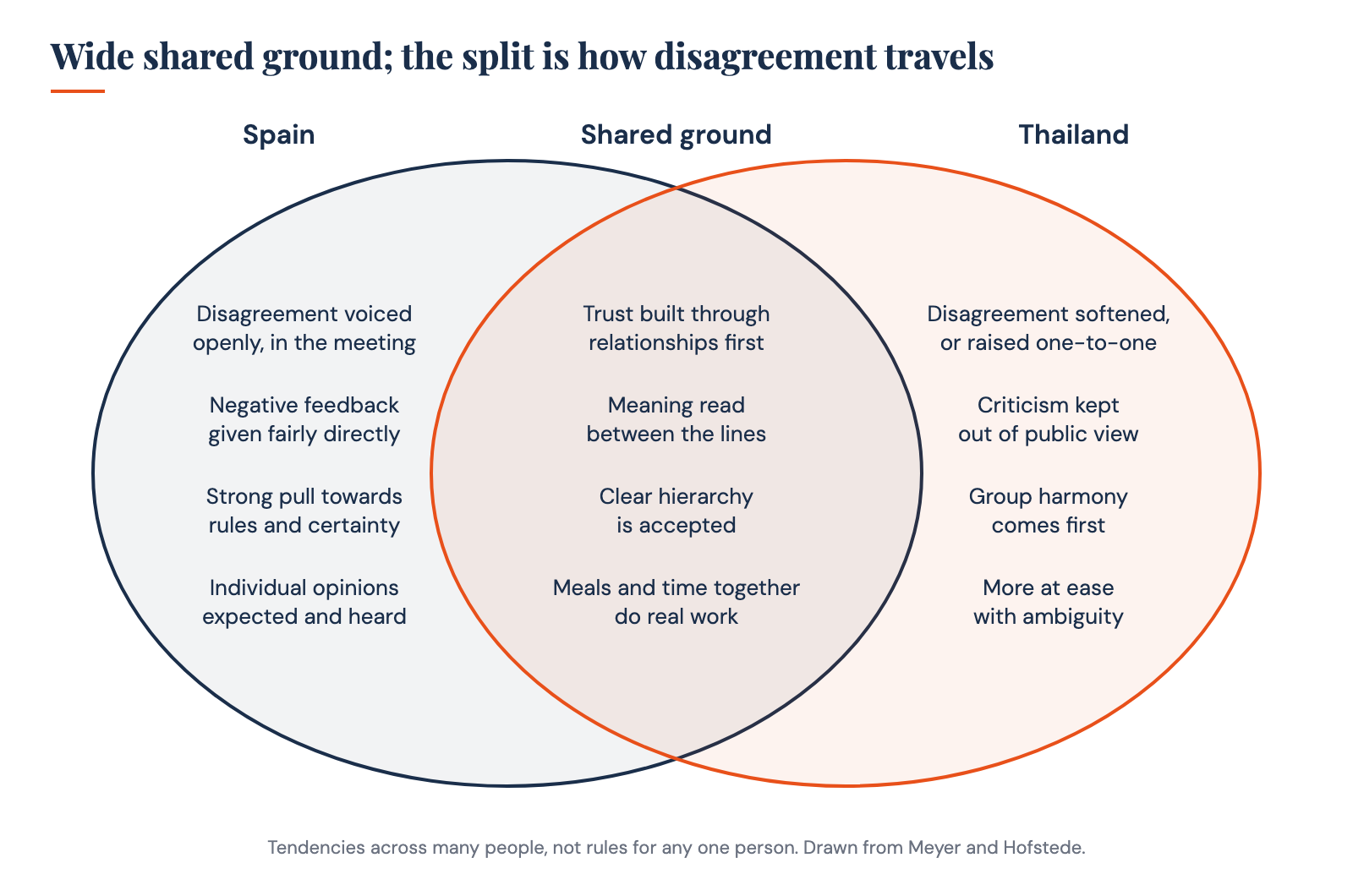
Read the full article: Cultural friction in Spanish–Thai teams isn’t where you think
Nationality tells you less than you’d think about which friction you’ll get
Status, generation and education all shift how someone works. Education tends to strengthen what a person’s own society rewards rather than making them “more Western”. And values change fastest in big cities, so a Bangkok head office and a provincial plant are not one “Thai culture”, any more than an Amsterdam head office and a regional plant are one “Dutch” one.
Face isn’t one thing either. Everyone protects it, but Thai draws finer lines: it has at least five words for it, from surface prestige to moral standing earned over years. A leader can keep the first and lose the second, and serious loss of face can feel like a moral verdict, not embarrassment.
That’s why these sessions use country patterns as a starting point, then work from your people, on both sides: who is senior, who is new, head office or site, and how each of them handles disagreement.
Sources: Steel & Taras (2010), Journal of International Management; Larry Persons, The Way Thais Lead: Face as Social Capital (2016).
Four ways to work together in Bangkok
Talk: Where friction really sits in Europe–Thailand teams
45 minutes plus Q&A, at your office or event.
For: Leadership offsites, all-hands, HR and business networks.
Chambers of commerce and professional networks: get in touch about a talk for your members.
THB 20,000 (about USD 600)
Book a call →Half-day workshop: Working across Europe and Thailand
3.5 hours, at your office, up to 20 people.
For: Mixed European–Thai teams, and the HR and L&D leaders who support them.
What the team leaves with: Shared rules for meetings, feedback and raising problems early.
Optional: a full cultural assessment for each participant beforehand (about an hour each).
THB 50,000 (about USD 1,500)
Book a call →Leadership-team session
A cultural assessment for each leader beforehand, a 3.5-hour session, and a team debrief. It can also run as two shorter sessions.
For: CHROs, managing directors and country heads with mixed leadership teams.
Based on the BASIS Leadership Programme.
THB 80,000 (about USD 2,500) for up to 10 leaders
Book a call →Open workshop with a chamber or network
3.5 hours, open to managers from member companies.
For: Chambers of commerce and business associations.
Per-person pricing, agreed with the organiser.
Book a call →Prices exclude VAT. All sessions are delivered in English. Availability between 22 February and 12 March 2027 is limited and is booked in order of confirmation.
From first call to follow-up
- Step 01A 30-minute call.We talk about your team and agree the right format.
- Step 02Short preparation.For leadership sessions, each leader completes my full Cultural Assessment Tool before the day: the in-depth version I use with client teams, not the free online profile. Workshop teams can add it too; it takes about an hour per person.
- Step 03The session in Bangkok.At your office, on a date between 22 February and 12 March.
- Step 04Follow-up from Barcelona.A written summary of agreements, and optional online coaching and mentoring to make the changes stick.
Who you’ll work with
Brendan Thomas Quinn is a Barcelona-based cross-cultural consultant and trainer. He spent eight years as a CEO leading organisations in Ghana, with partnership work in Togo and Burkina Faso, and now lectures in business communication for global teams at Harbour.Space (Barcelona and Bangkok) and in cross-cultural communication at SBS Swiss Business School Barcelona. He’s a member of SIETAR Europe and hosts the Cultural Friction podcast.
His cross-cultural training helps international teams turn cultural friction into a way of working everyone understands. More on leading multicultural teams and his cross-cultural training workshops in Europe.



Questions
Where do sessions take place?
At your office in Bangkok, or a venue you choose.
What language are sessions in?
English. They’re designed for teams where English is the shared working language and not everyone’s first language.
How many people can join?
Up to 20 for a workshop and up to 10 for a leadership-team session. Talks have no fixed limit.
Can we continue after you leave Bangkok?
Yes. Follow-up sessions and advisory run online from Barcelona.
Our team isn’t Spanish. Is this still relevant?
Yes. Spanish–Thai is one of at least three common patterns. Northern European and British managers meet different versions of the same friction, and teams that mix other cultures with Thai colleagues do too. The sessions start from your actual team, not from a country briefing.
How do we book?
Book a 30-minute call. We’ll agree the format and a date, and confirm in writing.
A really engaging and fun workshop, and a real added value to our team event. I hope we can work together again in the future.
Bangkok, 22 February to 12 March 2027
A limited number of sessions are available. Start with a 30-minute call.
Book a 30-minute call