Get this delivered to your inbox
Real problems, practical fixes for leaders of international teams. Published weekly.
✓ You’re subscribed. Check your inbox to confirm.
Cultural friction in Spanish–Thai teams
isn’t where you think.
Spanish and Thai colleagues have more in common than the briefings suggest. The gap sits in one specific place: what happens when someone disagrees.
Most briefings on working with Thai colleagues start with a list. Respect hierarchy. Save face. Don’t raise your voice. Most briefings on working with Spanish colleagues start with a different list. Relationships first. Long lunches. Plans that move.
Put the two lists side by side and you’d expect a clash. In practice, the overlap is bigger than the gap. The cultural friction sits somewhere much more specific.
More alike than the lists suggest
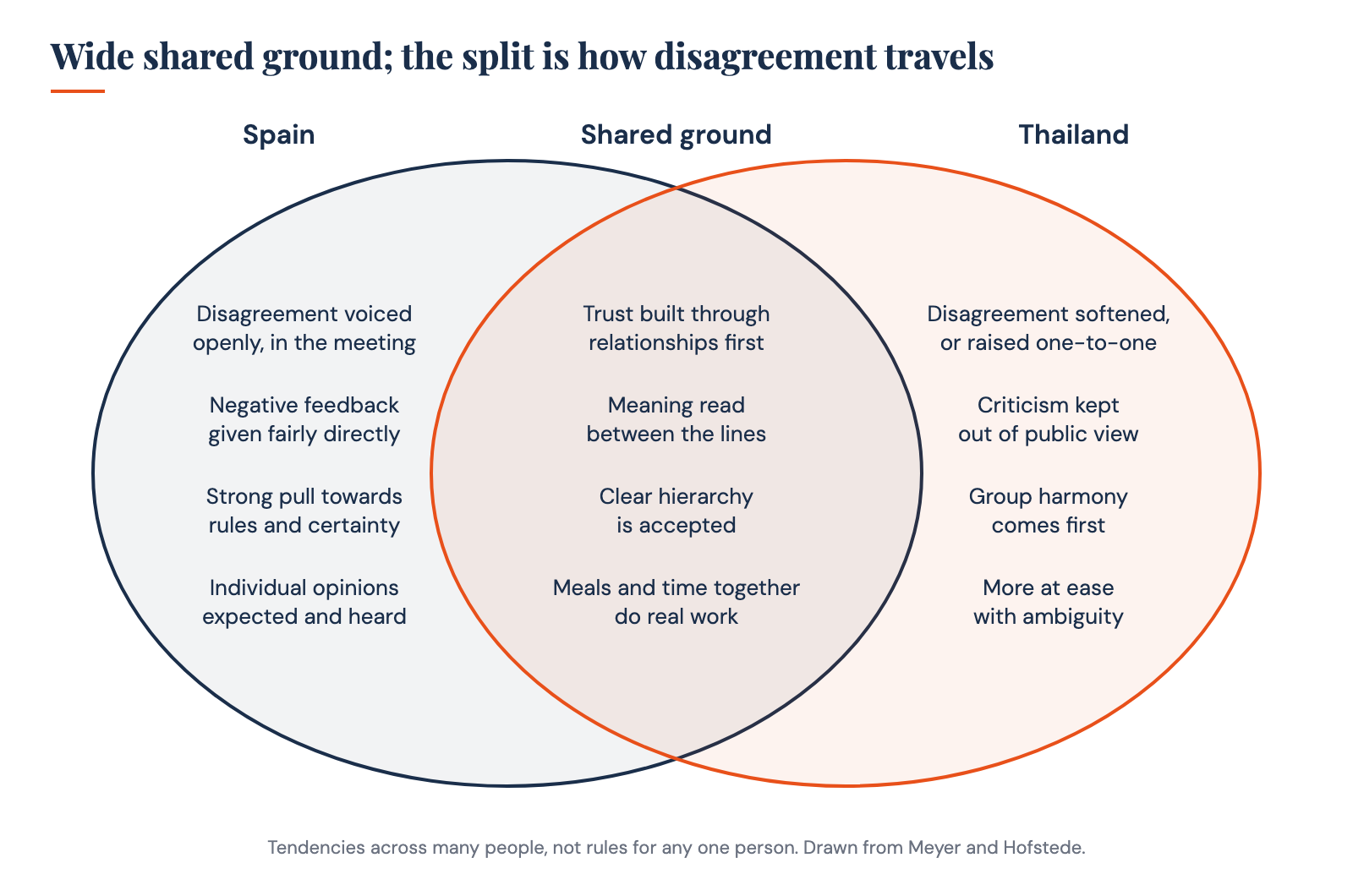
Both cultures build trust through relationships before tasks. Both read between the lines. In both, a meal is where real work gets done. Both are comfortable with a boss who is a boss.
So when a team spans Barcelona and Bangkok, the early weeks often go well. People like each other. Meetings feel warm. Nobody is shocked by hierarchy or by small talk before business.
That is exactly why the cultural friction, when it comes, is hard to see.
It’s also only one version of the story. “European–Thai” friction isn’t one thing. Northern European managers, direct and flat, tend to meet a louder version: they push back hard, which to them is engagement, and to a Thai colleague can feel like public pressure, so the Thai side steps back. British managers meet a more confusing one: both sides soften what they say, in different codes, and both leave thinking they understood. Spanish managers tend to meet the hidden version, and that’s the one this article is about. (All three are set out on my Bangkok sessions page.)

Where the cultural friction actually sits
The gap opens at a very specific moment: when someone disagrees.
In many Spanish teams, open disagreement is a sign of engagement. You push back, you argue the point, and you go for lunch afterwards. The relationship survives the debate, and often gets stronger.
In many Thai teams, open disagreement puts the relationship at risk. So disagreement doesn’t disappear. It changes shape. It arrives softened, late, or through someone else.
Two things make this harder for a Spanish manager to read. First, disagreeing with a peer isn’t neutral. In many Thai teams, colleagues who report to the same boss are quietly competing for that boss’s trust, so open disagreement with a peer can read as a move against them, not as healthy debate. Second, serious loss of face isn’t embarrassment. It can feel like a judgement on who you are, not on what you did, and that raises the stakes of every “robust exchange”. Neither side is doing anything wrong here. Each is being professional by the rules it knows.
Erin Meyer describes a Thai colleague who disagreed with her using four softeners in one sentence: “Maybe we could think about this slightly differently… perhaps… what do you think?” To a Spanish manager used to a robust exchange, that sentence sounds like agreement. It was a firm no.
I learned this the hard way on a construction site in West Africa. I said something to the team that I thought was ordinary. It wasn’t. That afternoon the site manager rang me: the whole crew had walked off and no longer wanted to work for me. I had insulted them without realising it.
Nobody told me directly. The men chose one person to carry the message, and only when I sat down with him one-to-one did I find out what had actually happened. The rest still didn’t want to see me.
The disagreement was never voiced in the room. It travelled through one trusted channel, and I only heard it once I went looking. Spanish managers in Bangkok often meet a quieter version of the same thing.
What it costs
The cost isn’t the awkward meeting. It’s the bad news that never travels.
A deadline slips in Bangkok. The local team signals it gently, in the way that protects everyone. Barcelona hears “it’s going well, maybe a few small challenges.” Three weeks later, the problem is a crisis, and both sides feel let down.
Neither side was wrong. Each was being professional by its own standards. That is what cultural friction looks like in practice: two sets of good intentions that don’t connect. Most intercultural problems in teams look like this.
Map people, not nationalities
None of this is a rule about Spaniards or Thais. A meta-analysis of 508 studies, covering about 500,000 people in 66 countries, found that 82–97% of the differences in people’s work values sit inside countries, not between them. Status, generation and education all shift how someone works, and values change fastest in big cities. A young manager in a Bangkok head office and a senior manager at a provincial plant may be further apart than either is from a Spanish colleague. The same goes for Spain: a Madrid start-up and a family firm in a smaller city won’t handle disagreement the same way.
So the pattern above is a starting point, not a verdict. The useful question isn’t “how do Thais disagree?” It’s “how does this person disagree, and with whom?”, asked about everyone in the team, Spanish and Thai.
What to do about it
None of these habits is specific to Spain and Thailand. They’re the everyday work of leading multicultural teams, aimed at the one place this pairing splits.
- Listen for the softeners. “Maybe,” “slightly,” “perhaps,” “it could be difficult” are signals, not filler. Treat them as the start of a conversation.
- Move disagreement out of the group meeting. Ask for views one-to-one, before the meeting, where nobody risks losing face in front of others.
- Ask questions that make bad news safe. Not “Is everything on track?” but “What would need to happen for this to slip?”
- Say how you want to hear problems. Many Spanish managers assume people will just tell them. Name it explicitly: early, private, and without penalty. Then show it’s safe: thank the first person who brings you bad news, and act on it.
- Check what the silence means. No objection in a call is not agreement. Follow up in writing and one-to-one. (More on this in The Silence Trap.)
None of this asks anyone to stop being Spanish or Thai. It asks the team to build a channel where disagreement can travel in both styles.
This is the work I do with international teams through cross-cultural workshops and coaching and mentoring. A cross-cultural workshop for a Spain–Thailand team usually starts exactly here: how disagreement travels. From 22 February to 12 March 2027 I’ll be in Bangkok teaching at Harbour.Space Institute of Technology @UTCC, and running a small number of cross-cultural workshops in Bangkok with teams that span Europe and Thailand.
The BASIS Leadership Programme · Level 2
Work on this with your own team in Level 2, session 2: Disagreement and conflict
One-to-one leadership and management training for managers of multicultural teams. You leave this session with a conflict map and a de-escalation script — built around your real team.
Level 2: managing multicultural teams → The leadership programme for multicultural teamsWork With Brendan
Leading a team across Spain and Thailand, and hearing bad news late?
That gap is usually fixable. A short call is enough to see where disagreement is getting lost in your team, and what would help it travel sooner.
Book a discovery call About the workshopNo obligation. 30 minutes. We’ll know quickly if it’s a fit.
Listen & Subscribe
Cultural Friction is now a podcast
The same real problems and practical fixes for leaders of international teams — now in your ears. Follow the show wherever you listen.
Free tool
Curious where you actually stand? The free Cross-Cultural Assessment gives you a short personal profile of your communication style, cultural intelligence, and psychological safety — in a few minutes, no cost.
Get your free profile →References
Meyer, E. (2014). The Culture Map: Breaking Through the Invisible Boundaries of Global Business. PublicAffairs.
Persons, L. S. (2016). The Way Thais Lead: Face as Social Capital. Silkworm Books.
Steel, P., & Taras, V. (2010). Culture as a consequence: A multi-level multivariate meta-analysis of the effects of individual and country characteristics on work-related cultural values. Journal of International Management, 16, 211–233.